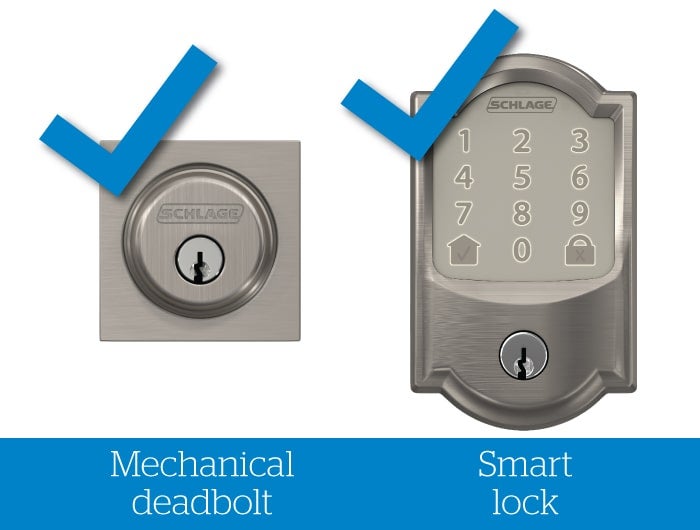
Smart locks and traditional deadbolts represent two fundamentally different approaches to home security in Nairobi. While traditional deadbolts rely on proven mechanical strength and zero power dependency, smart locks offer keyless entry, remote access, and integration with home automation systems. The choice between them depends on your budget, reliability concerns given Nairobi's power stability, and security features you prioritize.
Key Differences at a Glance
| Feature | Smart Locks | Traditional Deadbolts |
|---|---|---|
| Security Approach | Digital protection: fingerprint, PIN, app control, intrusion alerts | Physical strength: resists drilling and forced entry |
| Power Dependency | Requires batteries (6–8 months per charge) or solar options | Zero power needed—purely mechanical |
| Access Options | Fingerprint, PIN, app, voice commands, mechanical key backup | Physical key only |
| Remote Access | Lock/unlock from anywhere, temporary guest codes, entry alerts | No remote features |
| Smart Home Integration | Works with Alexa, Google Home, Apple Home, cameras, lights | No automation capability |
| Maintenance | Battery replacement every 6–8 months, low-battery alerts | Minimal—no maintenance required |
| Failure Risk | Battery depletion, app connectivity issues, electronic failure | Mechanical failure only, highly reliable |
| Installation Complexity | Moderate to complex (1,500–3,000 KES labor) | Simple (500–1,000 KES labor) |
| Price Range (Nairobi) | 10,000–45,000 KES total (lock + installation) | 2,000–10,000 KES total (lock + installation) |
Pricing Comparison in Nairobi
Smart Locks Prices (Kenya Shillings)
| Smart Lock Model | Type | Price (KES) | Features |
|---|---|---|---|
| OSL Fingerprint Lock | Fingerprint + App + Password + Card | 14,999 | Basic biometric access |
| OLL Series Biometric | Fingerprint + App + Password + Card | 16,500 | Multi-method unlock |
| Hotel Smart Lock | Password + Management System | 15,600–17,200 | Ideal for rentals |
| Gate Smart Lock | Waterproof + Fingerprint + App | 17,600 | Outdoor use |
| SENX4 Smart Lock | Smart connectivity | 26,750 | Aluminum plate mechanism |
| Keyless Biometric System | Biometric security | 29,999 | Advanced protection |
| LM1 Cat Eye | Fingerprint + App + Password + Card | 32,100 | Premium features |
| LM1 Ultra 3D Face | 3D Face Recognition + Fingerprint + App | 35,575 | Cutting-edge tech |
| LM Super Ultra | Biometric + Fingerprint + App + Password | 45,000 | Top-tier model |
Installation Cost: 1,500–3,000 KES per smart lock
Traditional Deadbolt Prices (Kenya Shillings)
| Deadbolt Type | Price (KES) | Installation (KES) | Total (KES) |
|---|---|---|---|
| Standard Deadbolt | 1,500–3,000 | 500–1,000 | 2,000–4,000 |
| Double Cylinder Deadbolt | 2,000 | 500–1,000 | 2,500–3,000 |
| 3 Lever Union Deadlock | 2,200 | 500–1,000 | 2,700–3,200 |
| Akkpes Deadlock | 3,500 | 500–1,000 | 4,000–4,500 |
| High-Security Deadbolt | 3,000–7,000 | 1,500–2,500 | 4,500–9,500 |
| Union Cylinder Deadlock | 4,000 | 500–1,000 | 4,500–5,000 |
| Yale Deadbolt Lock | 5,000–7,000 | 1,500–2,500 | 6,500–9,500 |
Installation Cost: 500–1,000 KES per deadbolt
Security Comparison
Smart Lock Security Advantages
Smart locks add digital protection layers that traditional deadbolts cannot match:
-
Fingerprint scanning and palm vein recognition provide biometric security that cannot be copied
-
Intrusion alerts notify your phone instantly when someone attempts unauthorized entry
-
Remote monitoring lets you check lock status from anywhere via smartphone app
-
Temporary guest codes allow time-limited access without physical key handover—ideal for Airbnb hosts or service workers
-
Entry logs show exactly when each person entered or exited
Traditional Deadbolt Security Advantages
Traditional deadbolts win for physical strength and mechanical reliability:
-
Quality models resist drilling and forced entry better than many smart locks
-
Zero electronic vulnerabilities—no hacking risk, no app exploitation
-
No power dependency means they work during electricity outages, common in Nairobi
-
Proven track record with decades of established security performance
-
Simpler attack surface—criminals must physically break the lock rather than bypass electronics
Reliability in Nairobi's Context
Power Stability Considerations
Nairobi experiences periodic power outages, making reliability crucial:
| Factor | Smart Locks | Traditional Deadbolts |
|---|---|---|
| Power Outage Impact | Fail if batteries die (6–8 months lifespan) | Completely unaffected |
| Low Battery Warning | Sends alerts 1–2 weeks before failure | Not applicable |
| Backup Options | Mechanical key backup, solar panels available | Mechanical key only |
| Internet Dependency | Remote features require WiFi/cellular | None required |
| Long-Term Failure Risk | Higher (electronics, battery, connectivity) | Lower (mechanical only) |
Smart locks like Lockin Veno Plus support solar panels for eco-friendly continuous power, mitigating battery concerns in sunny Nairobi.
Convenience Features
Smart Lock Advantages
Smart locks eliminate traditional key-related frustrations:
-
No more lost keys—fingerprint or PIN access cannot be forgotten
-
Lock/unlock from anywhere—let in guests, cleaners, or delivery personnel remotely
-
Voice commands via Alexa or Google Home for hands-free operation
-
Auto-locking when lights turn off or motion is detected
-
Multiple access methods—switch between fingerprint, PIN, app, or key
-
No rekeying needed when guests leave—just delete their PIN code
Traditional Deadbolt Advantages
Deadbolts offer simplicity and universal compatibility:
-
No app required—just use your physical key
-
Works with any keyholder—no technology learning curve
-
No battery anxiety—always works when you need it
-
Better for low-traffic doors—sheds, side entrances where smart features add unnecessary complexity
Best Use Cases in Nairobi
Choose Smart Locks If You:
-
Forget keys often—no more lockouts
-
Need remote access—perfect for busy lifestyles or frequent travel
-
Have renters or frequent guests—manage access easily from your phone (Airbnb, short-term rentals)
-
Want home automation integration—connect with cameras, lights, security systems
-
Live in Karen, Runda, Kileleshwa, or other upscale estates where smart home adoption is high
-
Value entry logs and security monitoring for peace of mind
Choose Traditional Deadbolts If You:
-
Prefer proven reliability—zero power dependency, no electronics to fail
-
Have budget constraints—50–70% cheaper upfront cost
-
Have low-use doors—sheds, side entrances, or secondary doors
-
Live in areas with frequent power outages—mechanical reliability matters more
-
Want simplest possible solution—no app setup, no battery monitoring
-
Need maximum physical strength against forced entry attempts
Hybrid Approach: Best of Both Worlds
Many Nairobi homeowners install both systems:
-
Smart lock on the main entry for convenience and guest access
-
High-security deadbolt as backup for maximum physical protection
-
Total cost: 15,000–55,000 KES for dual installation
This combination provides smart convenience while maintaining mechanical backup during power outages or electronic failures.
Final Recommendation
For Nairobi homes in established estates with reliable power infrastructure, smart locks offer superior convenience and modern security features worth the investment. The ability to monitor entry, grant temporary access, and integrate with home automation provides tangible benefits for busy professionals and rental property owners.
However, if you prioritize proven reliability, budget-friendly pricing, and zero dependency on electricity, traditional deadbolts remain the smarter choice. High-security deadbolts from brands like Yale or Union provide excellent forced-entry resistance at 1/3 the cost of smart locks.
Consider your lifestyle, budget, and power reliability when choosing. For ultimate security, many homeowners opt for both—a smart lock for daily convenience paired with a deadbolt for maximum physical protection.